
Vassar College is one of only eight institutions to receive the top grade on the Anti-Defamation League’s third annual Campus Antisemitism Report Card.
Read the full citation
A Long & Fascinating Conversation
An interdisciplinary academic program at Vassar College, established in the year 2000, drawing faculty from Religion, History, Anthropology, Greek & Roman Studies, English, Hispanic Studies, Italian, Political Science, Psychology, and Environmental Studies.
A standing invitation.
Jewish Studies at Vassar exists to encourage rigorous, hospitable, and pluralistic conversation about Jews, Judaism, and Jewish history, politics, culture and arts: the texts, the languages, the intellectual arguments. We teach the diversity of Jewish experience across multi-ethnic societies in the ancient, medieval, modern, and contemporary worlds, alongside such theoretical concerns as Diaspora, Zionism, religion, gender, and the construction of Jewish identity.
Jewish and non-Jewish students belong here equally. Some come because they have a strong Jewish background and want to interrogate it. Some come because they have none and want to begin. Most come somewhere in between, and find — at a place like Vassar, renowned for its open-minded expansiveness — that Jews productively complicate the conversation: what does it mean that Jews don't quite fit the available molds? What was the origin of this not-quite-fitting? How has it worked historically, and what do we do with it now? These are good questions to think about, and Jews are “good to think with” (to quote Claude Lévi-Strauss) about every minority living, surviving, and thriving among majorities.
You won't find pre-fabricated answers here. Why? Because Jews always answer a question with a question, don’t they? What you will find is a place where you can wrestle in earnest with sources, traditions, and disagreements; where Hebrew and Yiddish are taken seriously; where students travel — to Iberia, to Italy, to Central Europe — and read primary sources in situ; where invited speakers across a wide spectrum of approaches arrive each year to argue with us and one another. You are warmly invited in.
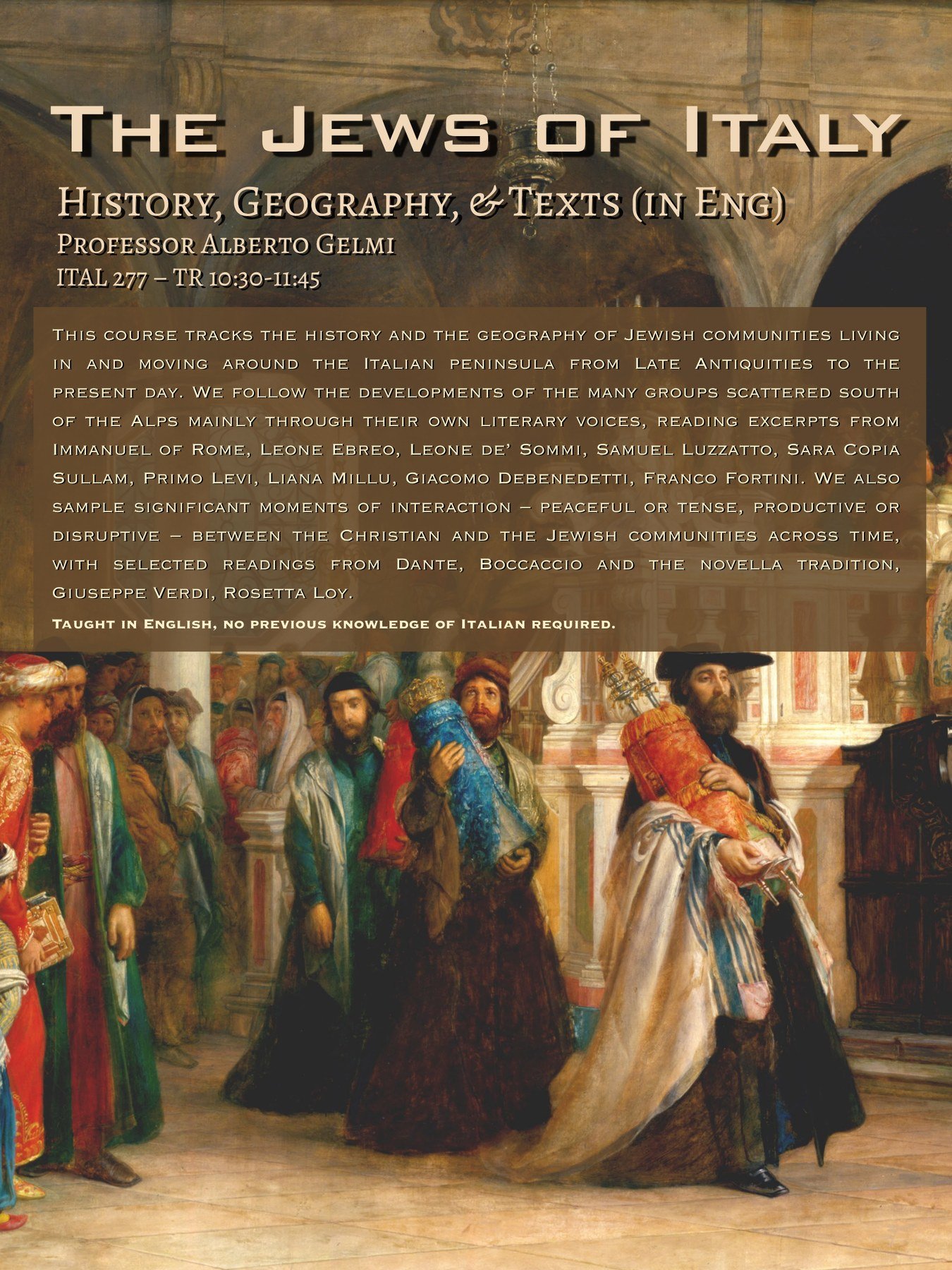
One of Professor Gelmi’s exceptional offerings — ITAL 277, The Jews of Italy: History, Geography, & Texts. Taught in English; no prior Italian required.
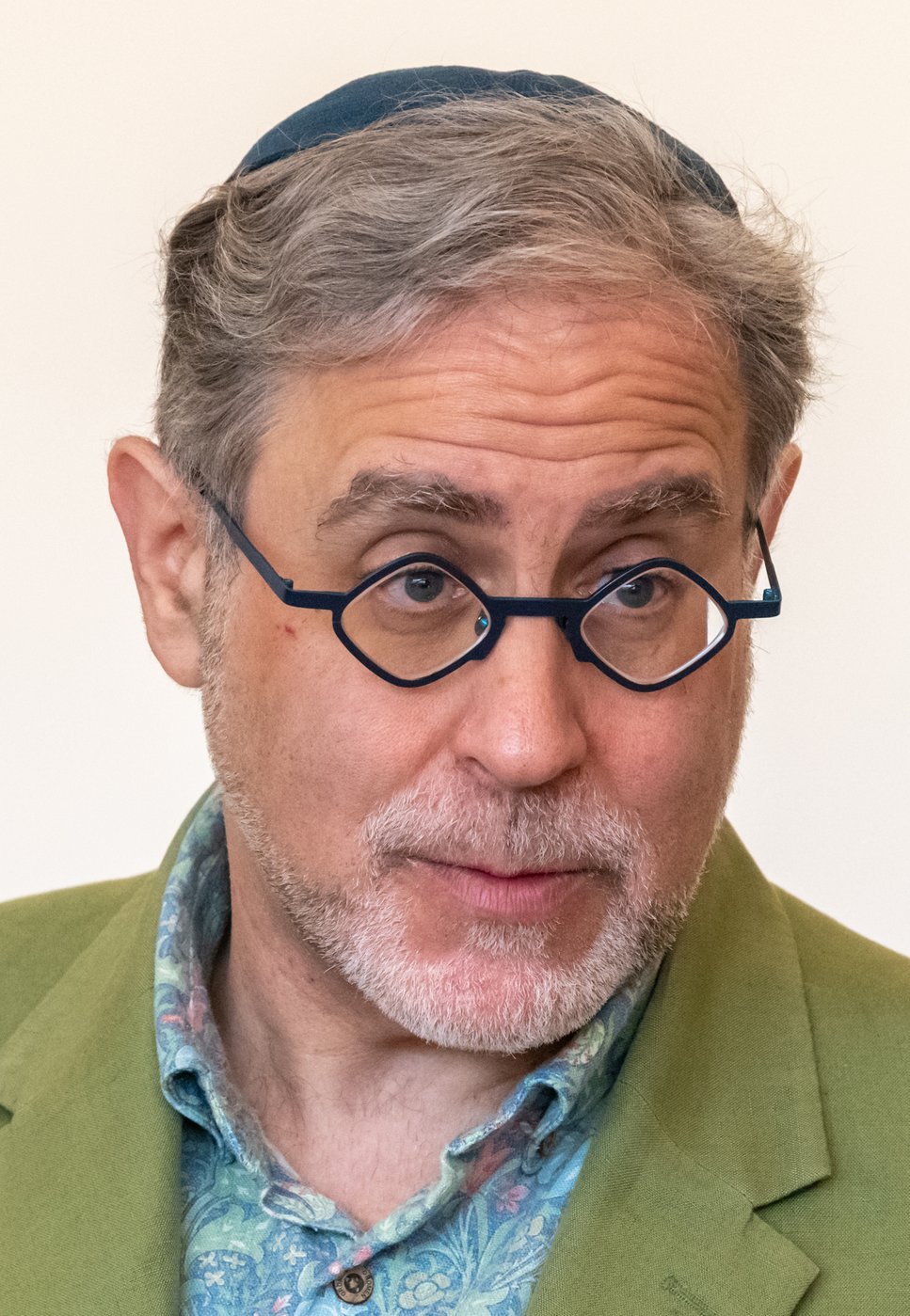
Four questions to begin with
From the Program brochure.
Major & Correlate Requirements
No prior background in the study of Jews or Judaism is assumed.
Students chart their own paths through Jewish Studies’ diverse methods and subject areas, identifying meaningful points of intersection while helping define an emerging field. In addition to core courses, students may count approved courses in Jewish culture from related disciplines, as well as approved junior-year-abroad coursework, toward the major or correlate sequence.
For current course catalog and credit-by-credit requirements, please consult the Vassar College Catalogue.
Courses Offered
A representative selection. Course offerings rotate; consult the catalogue for the current term.
A Note on the Program's Position
Jewish Studies & religious or political matters.
Jewish Studies at Vassar is an academic program. Its activities are restricted to academically-oriented events. By our mandate, we as a group may not advocate for any religious or political position. There is a wide diversity of opinion among our faculty on such matters, and individual faculty members are free, like any others, to comment as individuals; however, no individual faculty member is under any obligation — contractual or moral — to articulate, publicize, advocate, oppose, or defend any religious or political opinion. Views expressed by any faculty member are exclusively their own.
Get in Touch
Prospective students, alumni, parents, and visitors are warmly welcome. Sit in on a class. Meet with faculty.
Director. Professor Marc Michael Epstein · maepstein@vassar.edu · marcmepstein.com
Incoming Student Liaison. Rabbanit Dr. Ágnes (Ági) Vetö · agveto@vassar.edu · agvetowebsite.netlify.app