
Jews, Popes, and Foodways in the Roman Ghetto
Kenneth Stow, Professor Emeritus of Jewish History, draws on his most recent book, Feeding the Eternal City: Jewish and Christian Butchers in the Roman Ghetto (Harvard, 2024), to trace the intertwined food economies of Jews and Christians in early modern Rome.
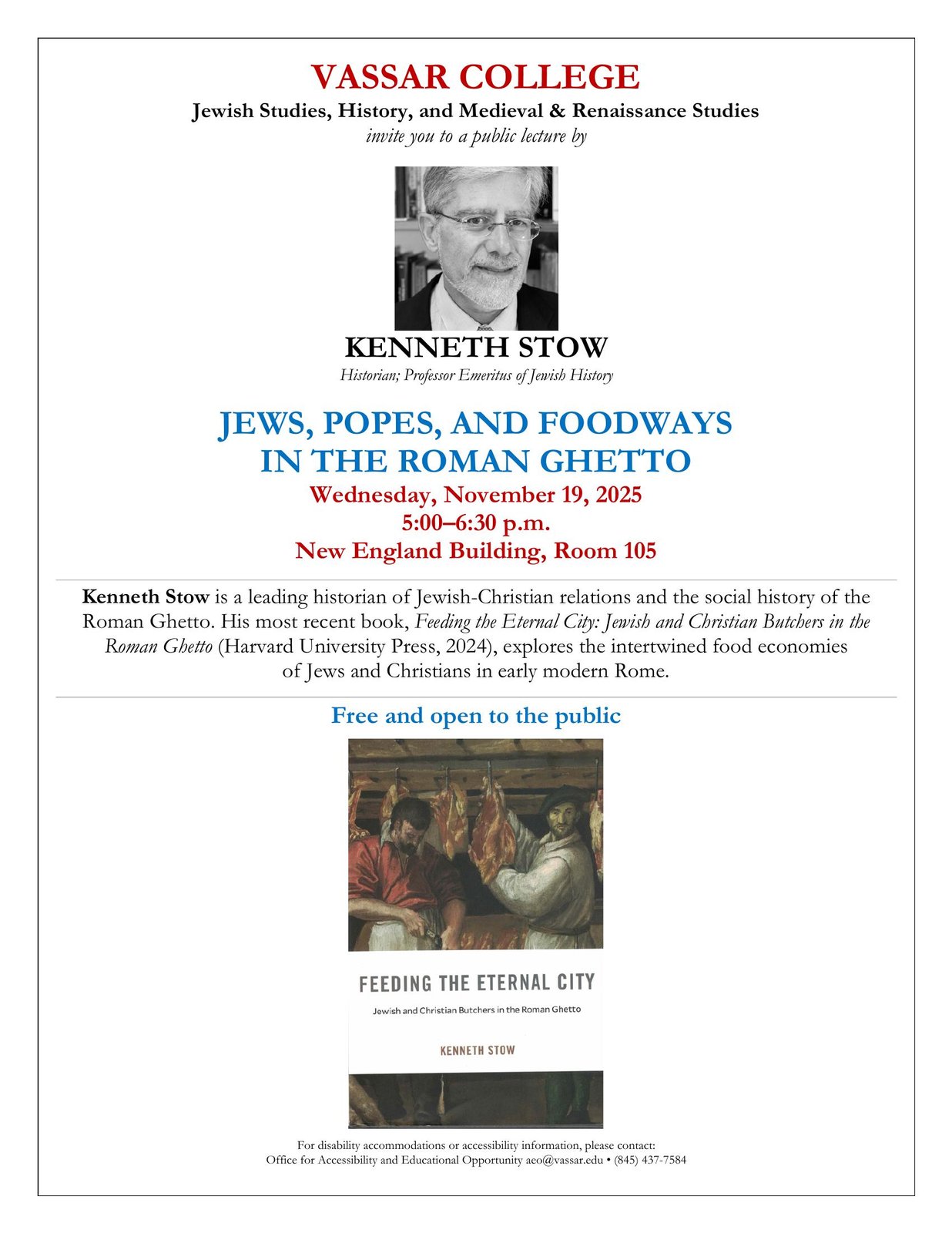
The Roman Ghetto, established by papal bull in 1555 and not formally dissolved until 1870, is often described in the language of separation. Stow’s recent work proposes a different picture: a daily life of exchange and mutual dependence, especially around the butcher trade. Jewish and Christian butchers shared streets, suppliers, customers, and a tightly regulated kosher slaughter that nevertheless served both communities. The food economy, in his telling, is where the abstractions of ghetto policy meet the concrete of city life.
About the speaker
Kenneth Stow is a leading historian of Jewish-Christian relations and the social history of the Roman Ghetto. Long associated with the University of Haifa, he is the author of, among many other works, Alienated Minority: The Jews of Medieval Latin Europe, Theater of Acculturation: The Roman Ghetto in the Sixteenth Century, and Anna and Tranquillo: Catholic Anxieties and the Roman Jewish Community in the Age of Revolution. His most recent book is Feeding the Eternal City: Jewish and Christian Butchers in the Roman Ghetto (Harvard University Press, 2024).
Sponsors: Jewish Studies, History, and Medieval & Renaissance Studies.