A long-arc research and teaching project that introduces Vassar students to the surviving centers of the Western Sephardi rite — Amsterdam, London, New York, Philadelphia, and beyond — to read the liturgy in situ, hear it sung in the buildings made for it, and study a tradition that is liturgically conservative and culturally cosmopolitan at once.
Why this tradition, for Vassar students
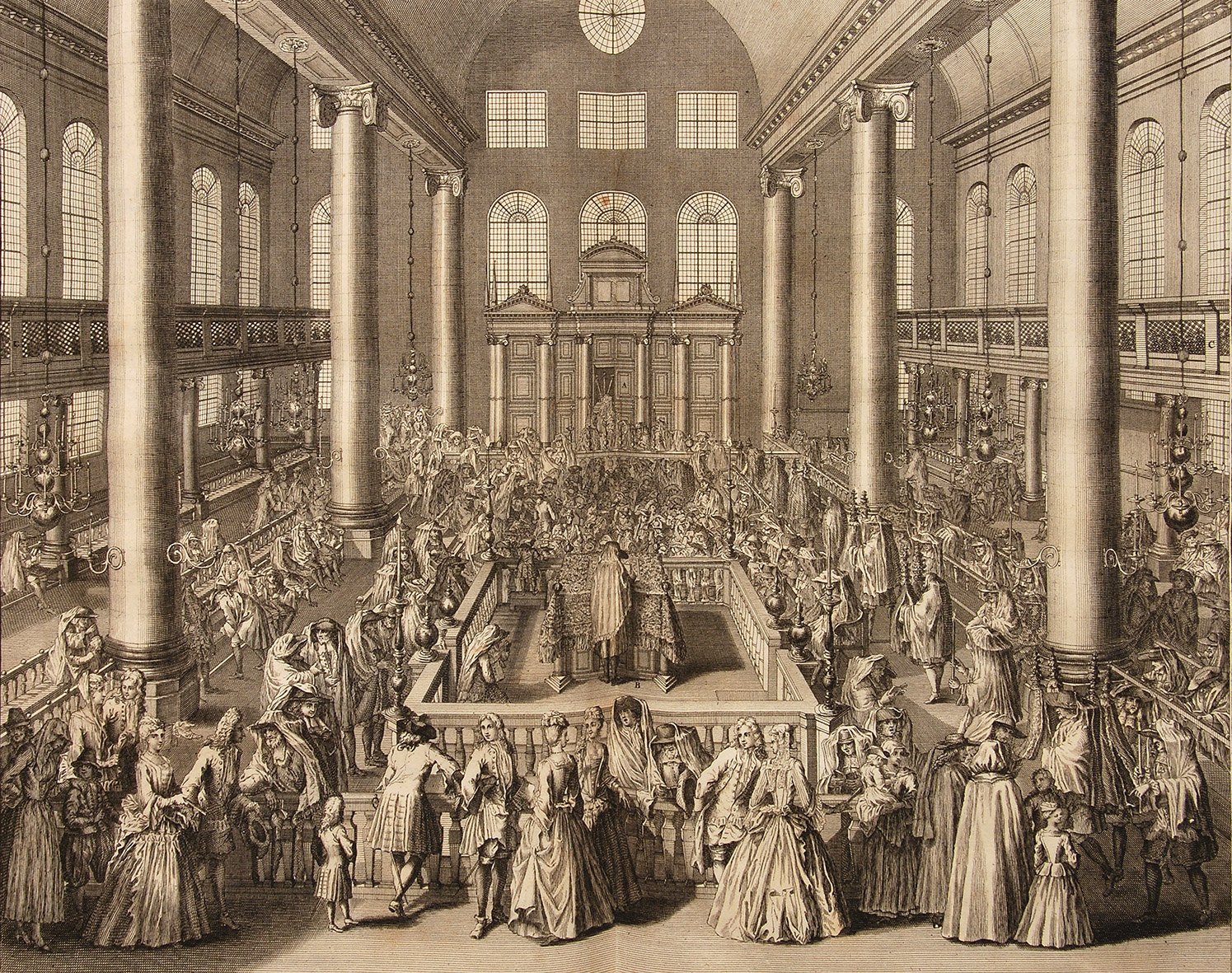
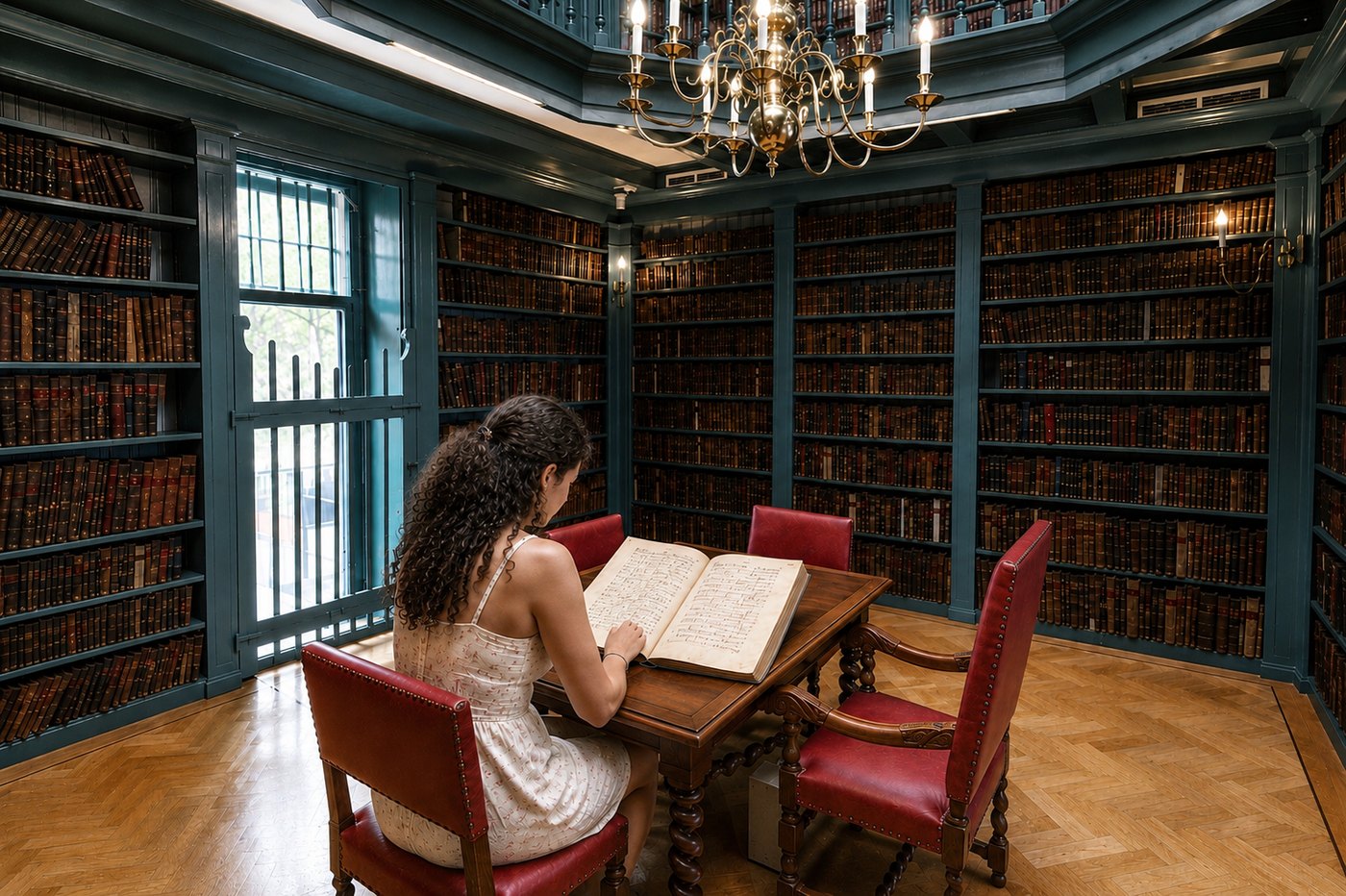
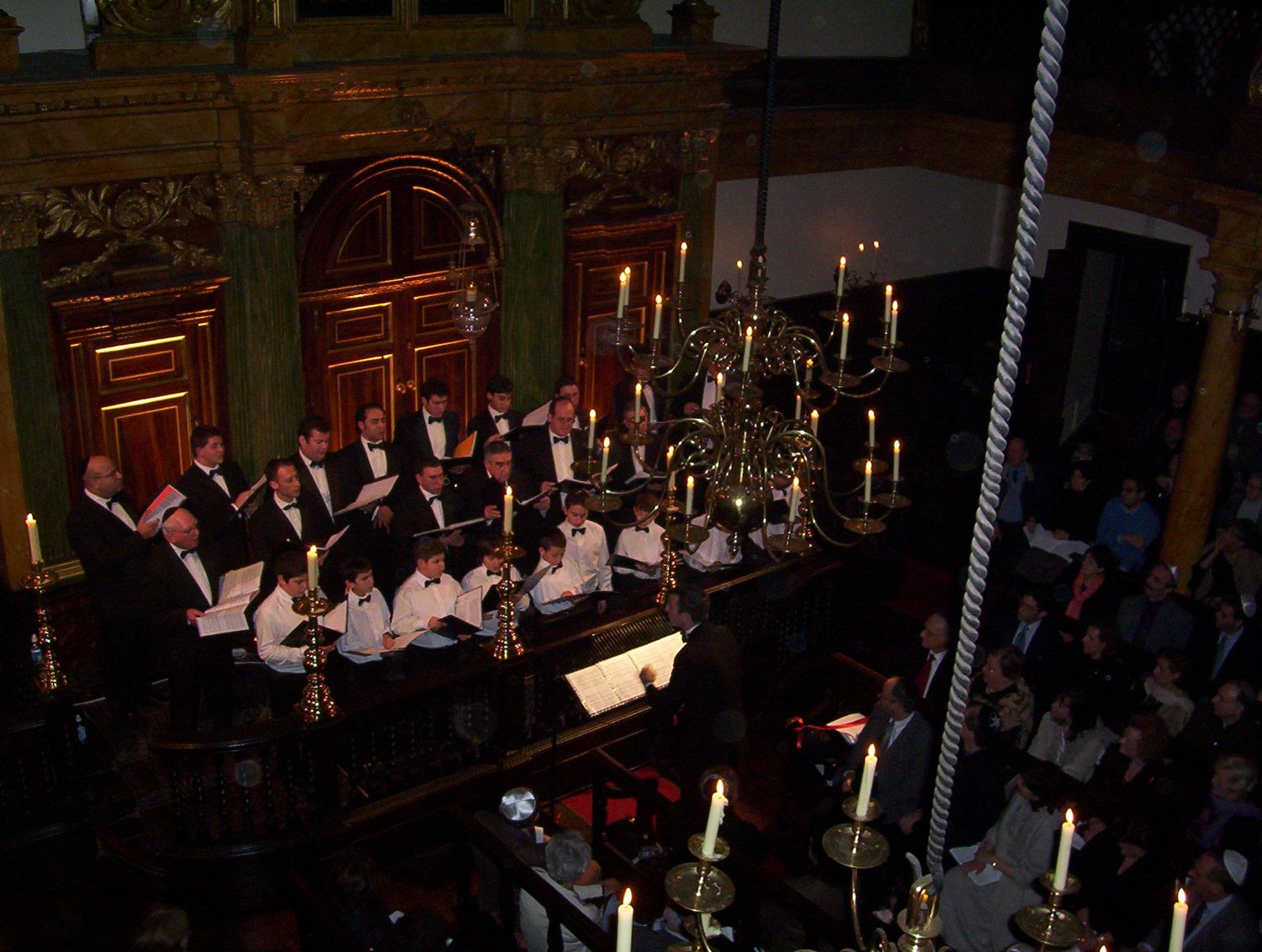
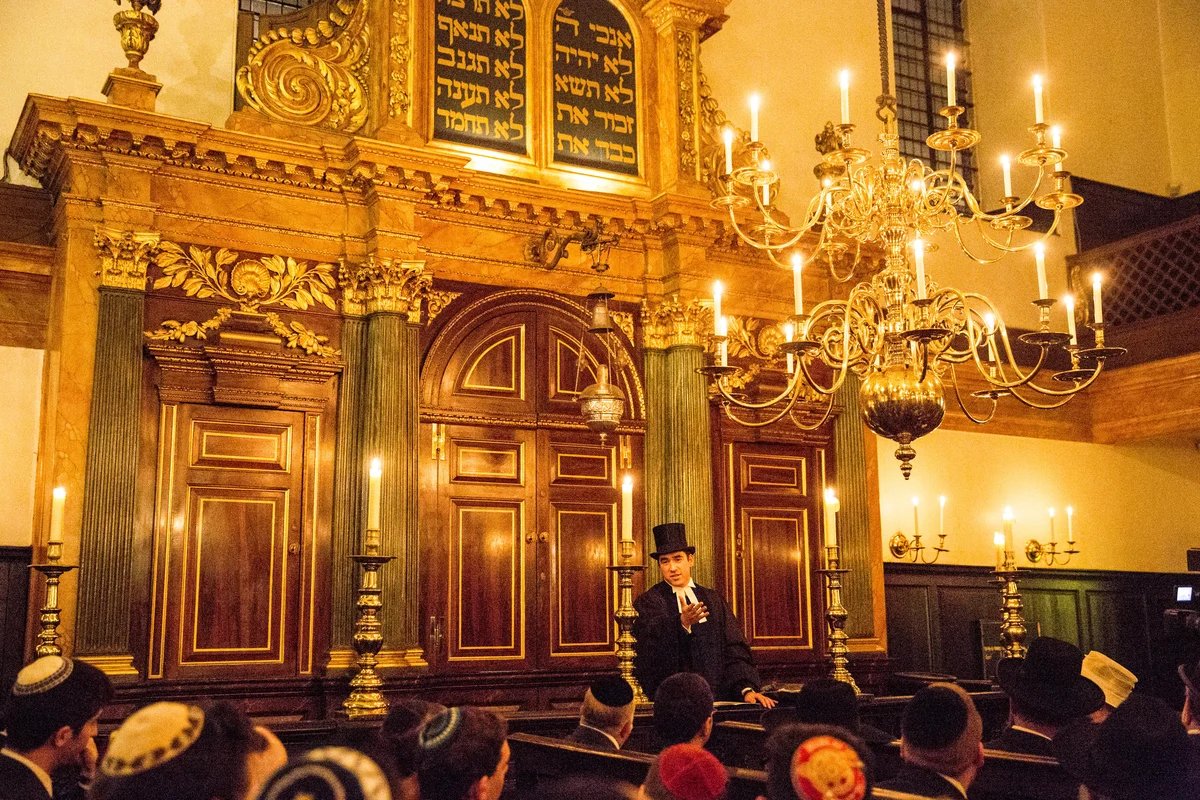
The dedication of the Synagogue of the Portuguese (Sephardic) Jews in Amsterdam. Picart & Bernard’s Religious Ceremonies, first English edition, 1733–37.Examining music manuscripts in the Ets Haim Library, Amsterdam.Choir of Bevis Marks in candlelit concert.
Most Vassar students arrive with two reference points for Jewish religious practice: Reform, the milieu of hometown synagogues, family seders, and summer camps; and Ashkenazi Orthodox and Ultra-Orthodox. There is some awareness, whether through family background or exposure to Israeli Jews, of Eastern Sephardim — Arabic, Persian, and Turkish speaking Jews from those cultures. Western Sephardi liturgy is none of these.
It is liturgically conservative. The wording of a service, the cantillation of the Torah, the melodies of the High Holidays, the choreography of a Friday night — nearly all of it has been kept virtually unchanged from its seventeenth-century crystallization in Amsterdam and London. The book is the same book. The tune is the same tune. There is nothing improvised, nothing modish, no rotating “creative service.”
But the cultural and intellectual posture the rite carries is unlike anything most students associate with that kind of conservatism. The Western Sephardi tradition, since its crystallization as a community of returning conversos in 1639 Amsterdam, has been culturally cosmopolitan and intellectually open: Manasseh ben Israel arguing for the Jews’ readmission to England; the Dutch–Caribbean trading houses; the choirs at Bevis Marks singing settings shaped by late Stuart and early Georgian English music; the Ashkenazi-by-birth philosophers and physicians who routinely affiliated with London or Amsterdam Sephardi congregations because they preferred their atmosphere. The tradition has never required suspicion of secular learning. It has never asked Jews to wall themselves off from the surrounding culture. Its sense of itself has always been comfortable with universities, with civic life, with Latin and English literature, with public conversation across religious lines.
For students moving between an inherited Reform and a more visible Ashkenazi Orthodox or an (often exotified) Eastern Sephardi milieu — Western Sephardi practice offers a third way that resolves a tension many of them feel: it lets one take traditional liturgy seriously without taking on the cultural and political commitments that have come to feel inseparable from American Orthodoxy. And it does so in a register that is aesthetically magnificent — when one thinks of the Esnoga, Bevis Marks, the choir loft at Lauderdale Road — and intellectually serious.
There is, additionally, a growing egalitarian Western Sephardi practice — in the work of Isaac Treuherz and Rabbi Adam Zagoria-Moffet’s Siddur Masorti, in Kehillah Kedoshah Zikhron Zvi, a new Western Sephardi congregation right here in the Hudson Valley and elsewhere — that preserves the rite while opening its leadership to women. For students at Vassar, this is neither an antiquated curiosity nor a post-modern compromise. It is a living tradition continuing to do what it has always done: keep the book, and adapt the community.
The four centers
The classical Western Sephardi congregations. Each is a living institution that students visit as part of the Project.
Amsterdam · 1675
The Esnoga
Portuguese Israelite Community of Amsterdam · Mother Synagogue of the rite
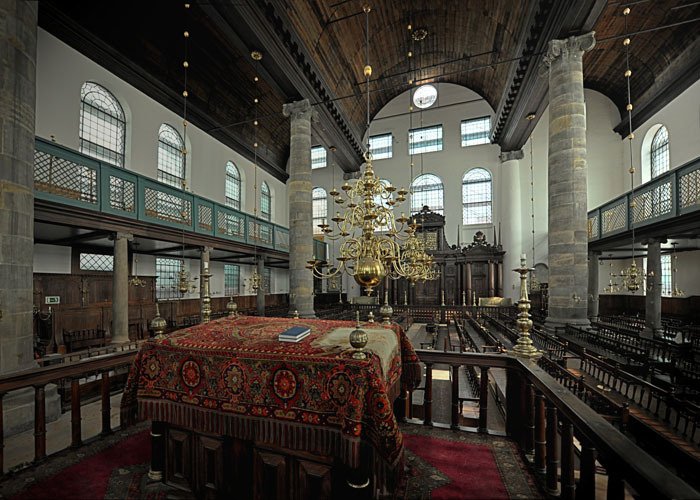
The building that crystallized the Western Sephardi rite: vast brick walls, sand-strewn wooden floors, ranks of brass chandeliers lit by hundreds of candles for Yom Kippur. The Esnoga has never been bombed, never been burned, never been converted. The service one hears there in 2026 is structurally the service that was heard there in 1675. The Esnoga is the institutional ancestor of every Western Sephardi congregation that followed.
London · 1701
Bevis Marks
Spanish & Portuguese Jews’ Congregation · the oldest UK synagogue in continuous use
Daughter of Amsterdam, opened in 1701 in the City of London. Grade-I listed, never closed, the only synagogue in Europe to have held regular services without interruption for more than three hundred and twenty years. Bevis Marks is where the Amsterdam rite met Anglophone musical culture, producing the choral tradition still sung in London today — the point of contact that the Program’s Colonial Harmonies project traces forward into the singing-school music of colonial America.
London · 1896
Lauderdale Road
Spanish & Portuguese Jews’ Congregation · West London home of the rite
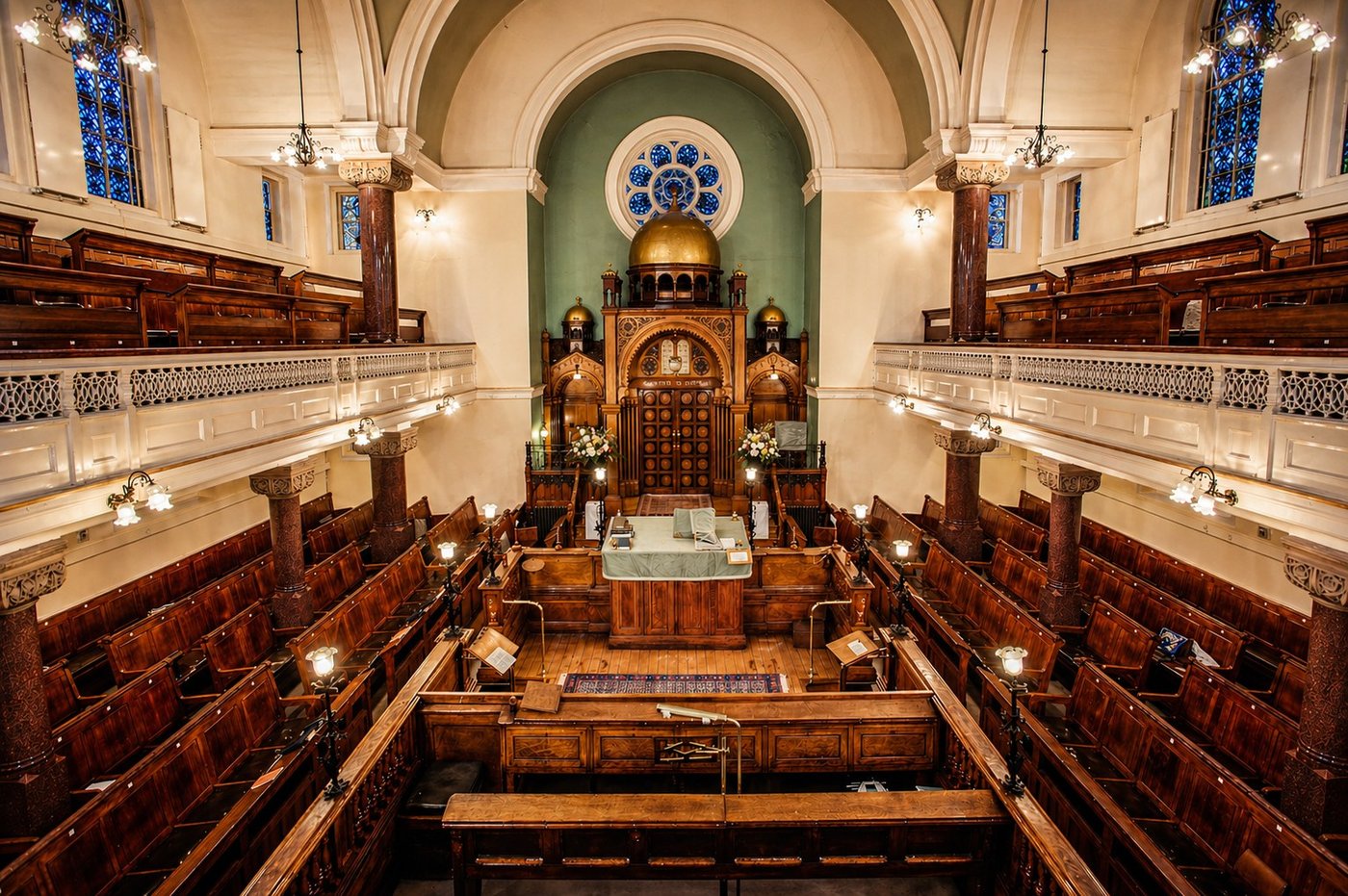
Opened in 1896 in a confident Byzantine Revival by Davis & Emanuel, Lauderdale Road was built to follow the congregation’s westward drift — by the closing decades of the nineteenth century, more than half its membership lived in Maida Vale and Bayswater rather than the City. It was the seat of Haham Moses Gaster from 1887 to 1917 (whose home, a few streets away, hosted the first meeting that led to the Balfour Declaration), and today serves as the administrative and liturgical center of the S&P Sephardi Community of the United Kingdom. The choral tradition first formed at Bevis Marks continues here in a larger, lighter, Anglo-Byzantine space; the Program’s Colonial Harmonies project draws on both London buildings’ musical archives.
New York · 1654 / 1730
Shearith Israel
Congregation Shearith Israel · the oldest Jewish congregation in North America
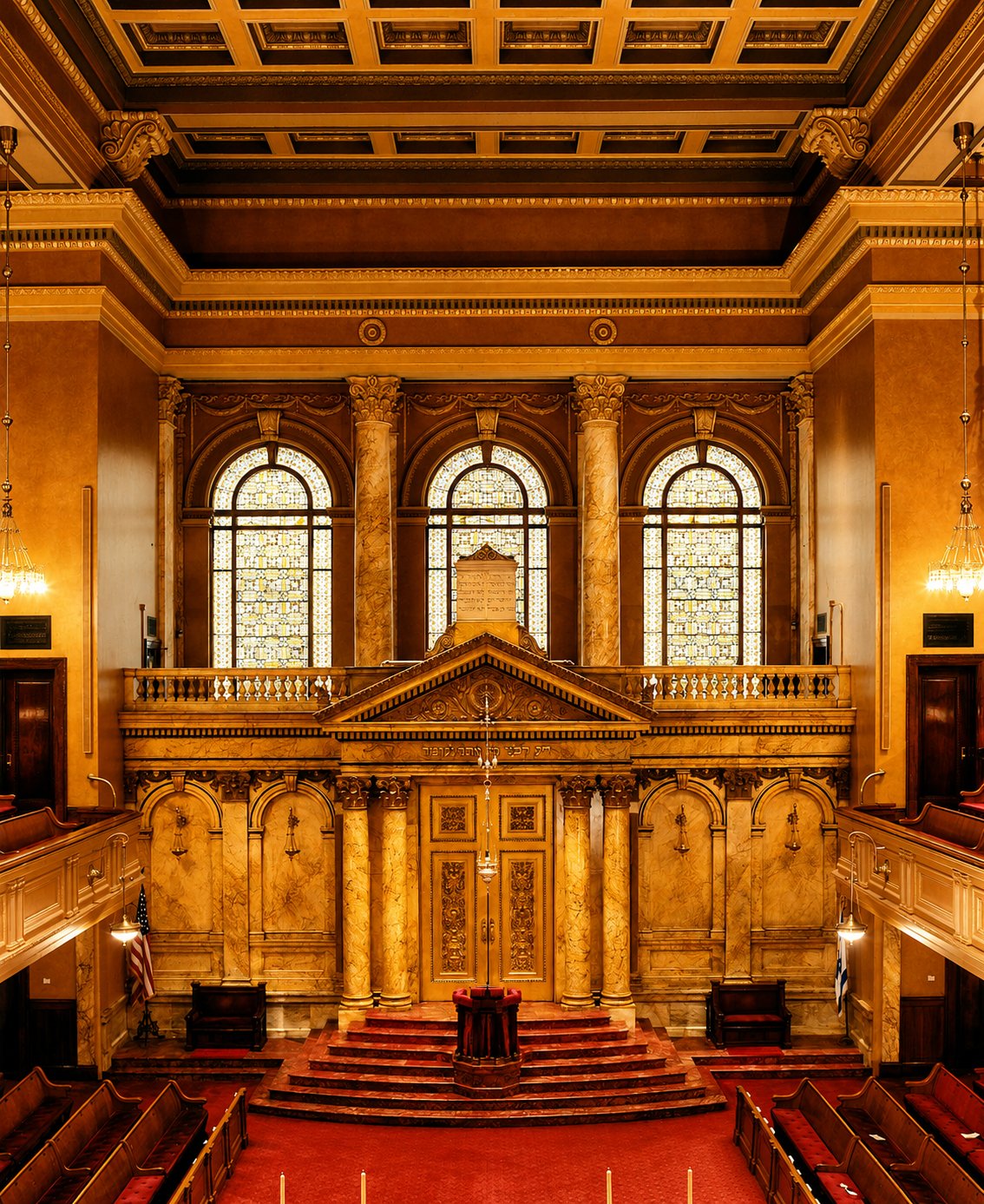
Founded in 1654 by twenty-three Sephardi refugees arriving in New Amsterdam from Recife. Its first purpose-built synagogue, the Mill Street Synagogue, was consecrated in 1730 with Luis Moises Gomez — a resident of the Hudson Valley — as first Parnas. The congregation’s current home, on Central Park West and 70th Street since 1897, still uses the Amsterdam–London rite essentially as Gomez heard it on Mill Street three centuries ago.
Philadelphia · 1740
Mikveh Israel
Congregation Mikveh Israel · the Western Sephardi rite in the Quaker City
The fourth of the classical centers. Founded in 1740 in colonial Philadelphia by the same trans-Atlantic network of Sephardi merchant families — the Phillips, the Nones, the Gratzes — and consecrated by Haym Salomon, financier of the American Revolution, among its earliest members. Mikveh Israel preserves the rite in an American republican key, and the building’s archives are a major source for the project’s research on Sephardi liturgy in the early Republic.
Future centers
As the project grows, the travel seminar will reach the rite’s further outposts and unexpected survivals.
Paris
Rue Buffault
The Synagogue de la rue Buffault — a Belle Époque Sephardi congregation in the ninth arrondissement, where the Amsterdam–London rite meets late-nineteenth-century French Jewish musical practice.
Manchester
Sha‘are Hayim
The Spanish & Portuguese congregation of Manchester, founded by Mediterranean Sephardi cotton-merchant families in the nineteenth century — the rite refracted through British industrial Manchester.
Curaçao
Mikvé Israel-Emanuel
Consecrated 1732 in Willemstad — the oldest continually operating synagogue in the Americas, with the sand floor of its mother in Amsterdam preserved as a memorial.
Indonesia
Surabaya & Tondano
The tiny surviving Sephardi-rite communities of Java and northern Sulawesi — the eastern end of an Iberian-Dutch-Caribbean trade network that never fully went out.
What students do
The project is built around the principle that liturgy must be read in situ: in the buildings made for it, with the books used in them, in the congregations where it continues. Vassar undergraduates regularly accompany Professor Epstein for week-long study residencies at the four centers, sitting in services, working with the congregations’ archives, and recording melody and minhag with the cantors and choirmasters.
The fieldwork feeds three streams. The first is archival: locating, transcribing, and cataloguing the printed and manuscript prayer books, communal records, and musical notations preserved in each congregation. The second is musicological: making field recordings of the rite as currently performed, in dialogue with the existing critical editions and recordings of Western Sephardi music. The third is scholarly: senior theses, independent studies, and the interactive historical map of three millennia of Jewish liturgical influence — the project’s most public-facing product.
The travel work is closely linked to the Program’s sister project, Colonial Harmonies, which brings the Western Sephardi rite into conversation with the earliest liturgical music of Colonial America. Together the two projects take the Western Sephardi tradition as a living frame for Jewish Studies at Vassar — a continuing intellectual and musical practice.
An Archive Recovered
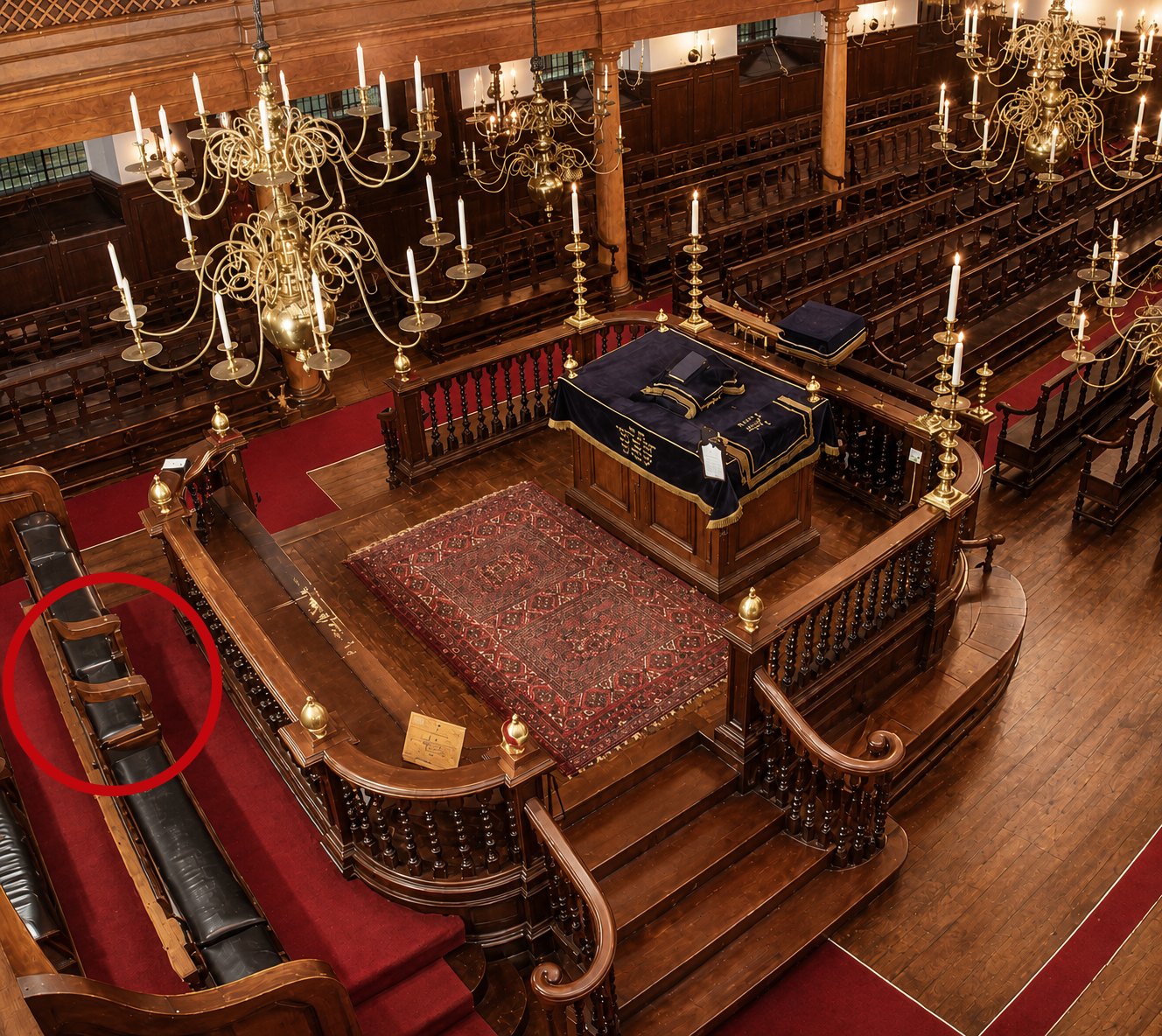
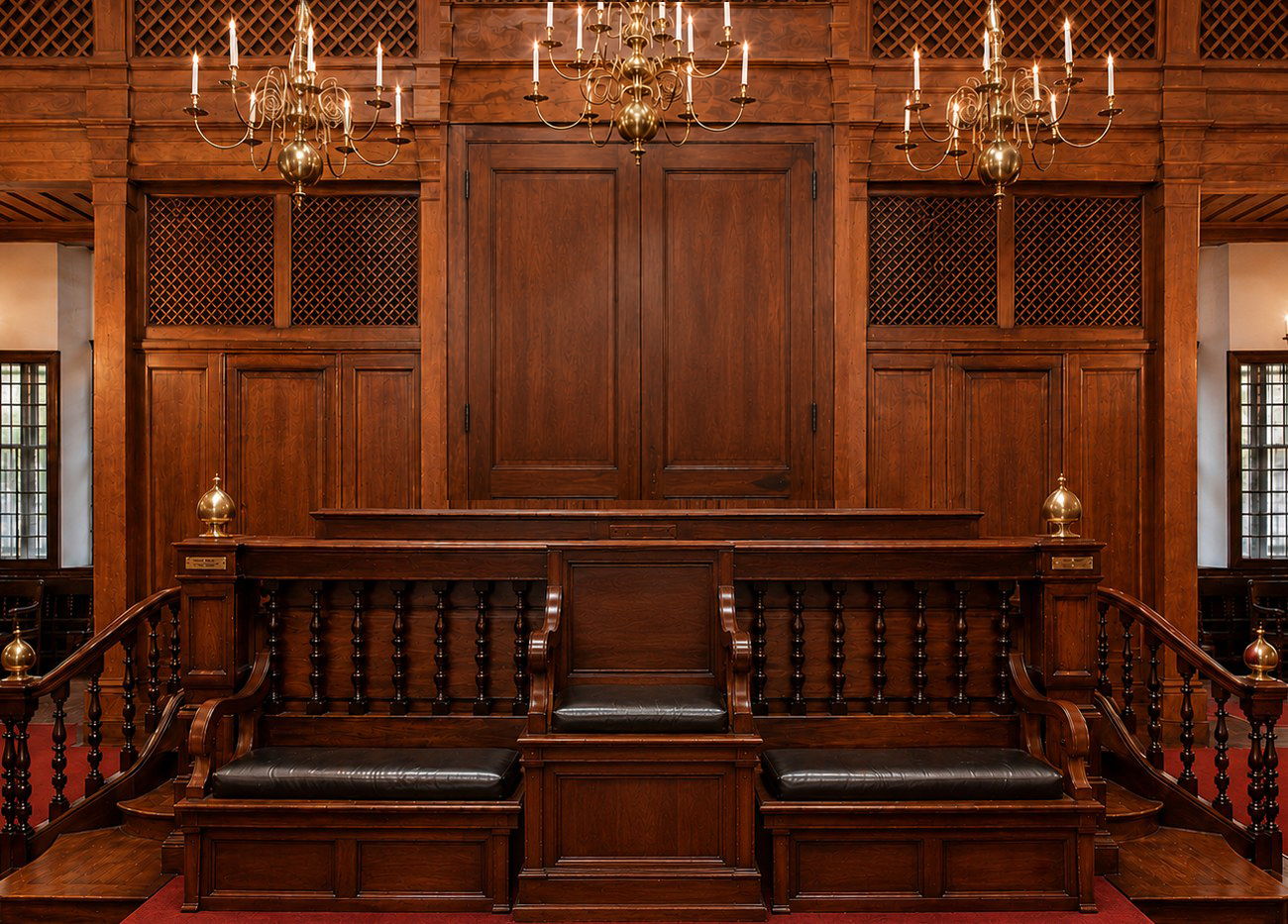
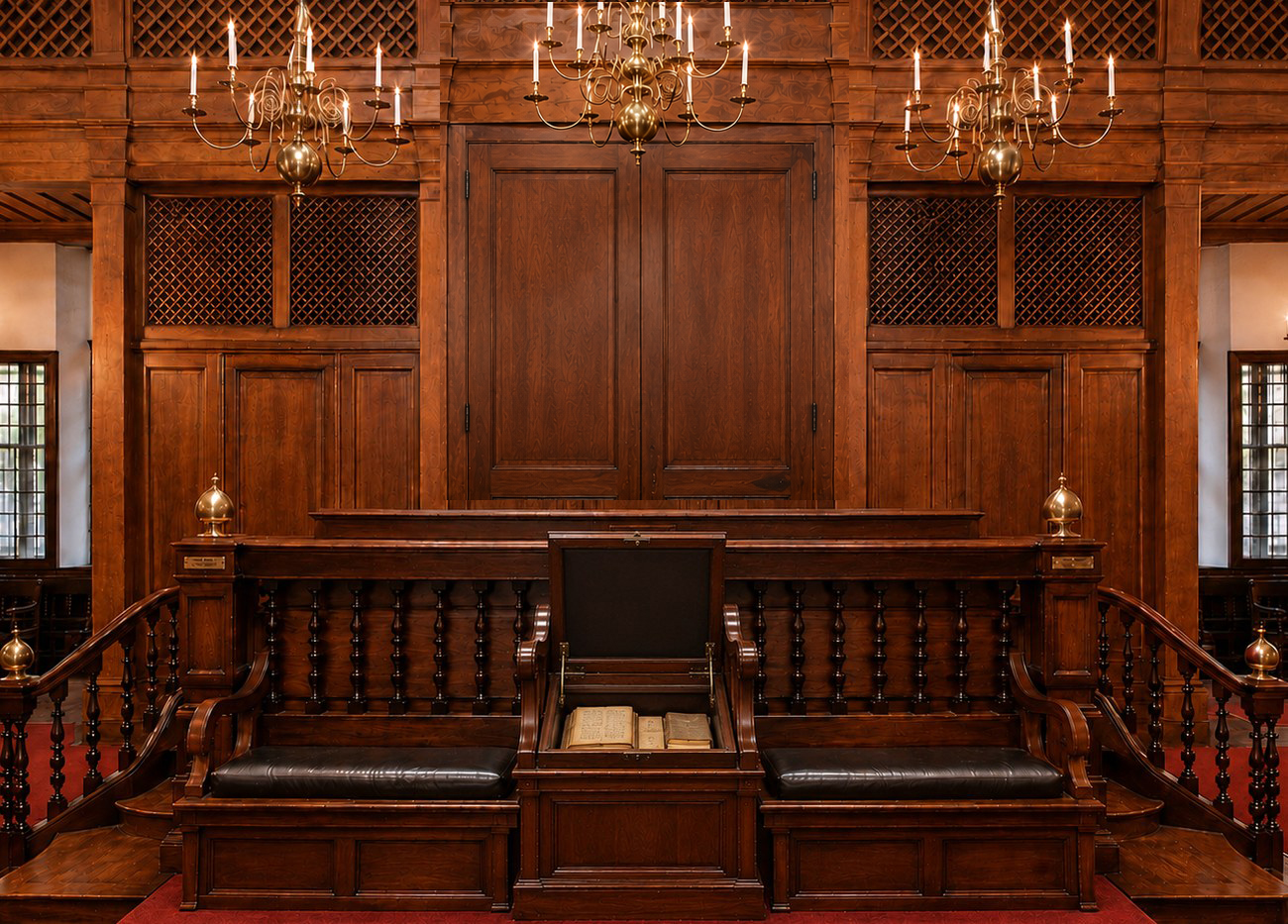
Location of choirmaster’s seat.
Our students discovered a rich archive of liturgical books and manuscripts right under the Choirmaster’s seat at Bevis Marks.
A Hudson Valley endpoint
The project’s liturgical home is Kehillah Kedoshah Zikhron Zvi, an egalitarian Western Sephardi congregation in Poughkeepsie that follows the rite of Amsterdam, London, and New York — the same liturgical tradition that Luis Moises Gomez carried up the Hudson three centuries ago. The fieldwork comes home there: archival findings are tested, melodies are sung in services, students can see the rite not as fieldwork material but as the prayer life of a living congregation.
The historical map is built after Aharon Varady · Open Siddur Project, A Historical Map of Jewish Liturgical Influence & Variation, used and adapted under Creative Commons BY-SA 4.0. The outlined boxes in the original follow Joseph Heinemann, HaT’filah biT’kufat haTanaim veha’Amoraim (Jerusalem: Hebrew University, 1966). The illustration of birds in the source chart is by Barbara Wolff, after Psalm 104: among the branches they sing.
Your gift sustains financial aid for our travel seminars, public lectures, language teaching, and the Sefer Torah restoration. Use designation DA059 – Jewish Studies.